Glimmer of A Grove Beyond
Thank you for your interest in hosting Glimmer of a Grove Beyond and for your commitment to raising awareness about Palestine through art and visual culture.
This guide provides clear, step-by-step instructions on selecting the exhibition components and accompanying visual materials, as well as how to print and display them. The Palestinian Museum team will support you throughout the process of bringing the exhibition to life in your chosen space.
The exhibition features 32 curated political posters from the Palestinian Museum’s permanent collection, generously donated by former ambassador Ali Kazak. Organized into seven thematic sections—Sowing Liberation, Agency and Sanctity, Devastation as Landscape, Manifesting Palestine, Fida’i, Flowers and Anemones, and Reclaiming the Orange—the exhibition explores how Palestinian land and geography have been represented in visual culture. These themes highlight artistic portrayals of resistance, dispossession, identity, memory, and the ongoing relationship between people and land.
To enhance your audience’s experience, the exhibition package includes a short video tour and a media kit to support your outreach efforts. We also provide optional memorabilia designs that you may print and share locally. These items serve as meaningful extensions of the exhibition’s themes, encouraging reflection on landscape, memory, and resistance in Palestinian visual culture.
Exhibition guide
This guide explains how to download, print, and curate this exhibition in your space of choice.
Step 1
Choose a space and its dimensions
Whether it is a gallery space, lobby, corridor, interactive hall, or a sidewalk, take dimensions of the usable walls, to be able to decide which format will fit in the allocated space. Take into consideration the audience flow, and the lighting source.
Step2
Design the exhibition layout
Based on your available space, select the poster size that best fits your setting, and design your layout using the available size options.
This guide includes step-by-step instructions for printing and setting up the “Glimmer of a Grove Beyond” exhibition. It provides details on poster dimensions, display options, and layout suggestions to help you create a compelling and visually impactful exhibition that tells the story of Palestine through posters.
Step3
Download
Download the full-size version, the A3 version, or any combination you prefer from the list below. Options include one version in both Arabic and English, and another in English only.
Lets announce your exhibition
Social media kit
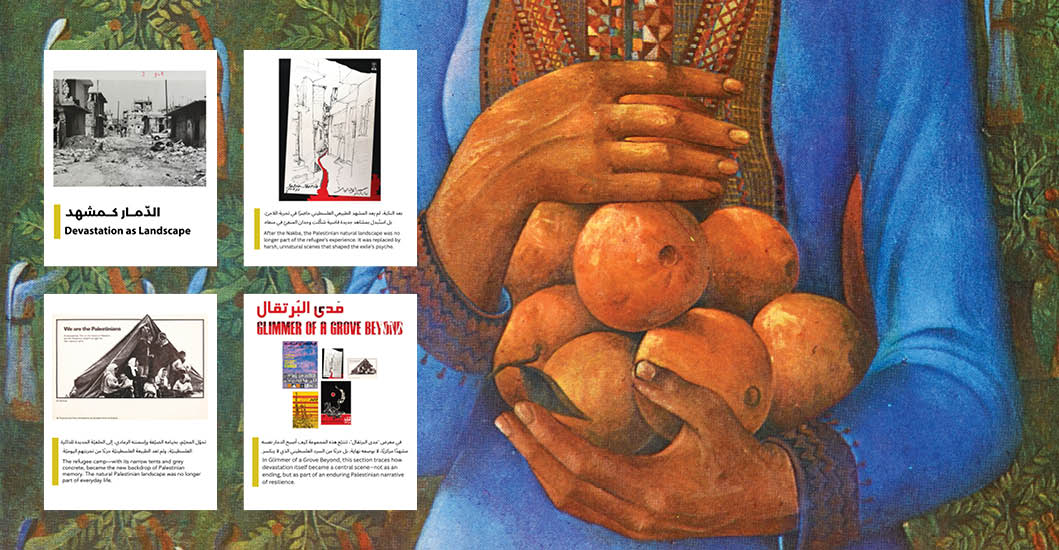
How to use the social media kit: Glimmer of a Grove Beyond is supported by a tailored media package designed to help you promote the exhibition across your social media platforms and expand its reach and impact.
The kit includes:
- Two video reels
- A main exhibition poster
- Four thematic posts, each highlighting a distinct aspect or story within the exhibition.
We encourage you to follow the suggested publishing flow to create a consistent and engaging online narrative:
Suggested Publishing Schedule:
- First post:
Share the video reel featuring the main exhibition poster to announce Glimmer of a Grove Beyond. Tip: Add background music from Instagram (or any platform you’re posting on) to increase reach and engagement.
- Second post:
Share the exhibition poster as a still image post.
You can add your exhibition’s location, date, and time in the designated area on the poster, and include any additional details (partners, entry information, credits, etc.) in the caption. - Next posts:
Share the four thematic posts, each highlighting a specific topic or story from the exhibition.
You may post them on consecutive days or schedule them at different times, depending on your platform strategy. - Finally:
Share the second reel, either between the thematic posts or after them, to sustain visibility and engagement.
Notes & Guidelines:
- To increase visibility, we encourage partners and collaborators to align their posting schedules when possible — synchronized releases help maintain steady momentum and reach.
- All reels and posts are titled after the themes they represent.
- You can post during the peak engagement hours on your chosen platform.
- Please use the unified hashtag #Glimmer-of-A-Grove-Beyond on all your related posts to connect the campaign and enhance discoverability. You can also include related hashtags such as #PalestinianPoster, #PoliticalPoster, #PalestinianArt, #CulturalResistance, #VisualMemory, and #ThePalestinianMuseum.
- Tag the official accounts of the Palestinian Museum on Instagram, Facebook, TikTok, LinkedIn, and X (Twitter). This allows us to reshare your posts and amplify your visibility.
- We encourage you to collaborate with local cultural figures, artists, and media professionals who can help amplify the exhibition’s message and reach.
- Invite your local press to cover the exhibition and share its story!
- Don’t forget to share photos or short clips from your hosting of Glimmer of a Grove Beyond — we’d love to repost them on our official channels and website, giving credit to your space.
• You can download the media package through this link.
Together, let’s share the light of Glimmer of a Grove Beyond — visual journeys through the landscape.
Step5
Video Tour of the Exhibition
Use the video tour to engage your audience: share it online on your platforms or screen it in your exhibition space.
Step6
Merchandise and giveaways
We are sharing with you a selection of images and visual elements, including the logo of the “Glimmer of a Grove Beyond” exhibition, inspired by its visual identity, to serve as a source of inspiration for creating your own designs and promotional materials—such as pins, stickers, and other items that reflect the spirit of the exhibition and align with your aesthetic vision.
The attached images are not intended for printing, but you may draw inspiration from them to develop your own designs. You may also use symbols or elements from the original posters, as outlined in the design guidelines, to create visuals that carry the essence of the exhibition wherever it is displayed.
Step7
Partner evaluation form
We kindly invite you to take a few moments to complete our evaluation form. Feedback on your experience with the exhibition is valuable to us, as your insights will help us improve the resources we have to offer. To start the evaluation please click here.